


October 2026 – Market Update
Brings More Balance—and More Room to Negotiate
Austin’s housing market entered October with steady prices, roughly five months of inventory and homes selling a little faster than they did last year. For buyers and sellers, that creates opportunities—but the right strategy still depends on the property and its neighborhood.
The bigger story is sales volume. Activity is improving compared with 2025, yet Austin is still closing significantly fewer transactions than it did before the pandemic. Understanding both sides of that picture helps explain what’s happening on the ground.

A look at the numbers
September recorded 659 closed sales, down 9% from a year earlier and 11.4% from August. The average sale price was $837,743, up 9.7% year over year.
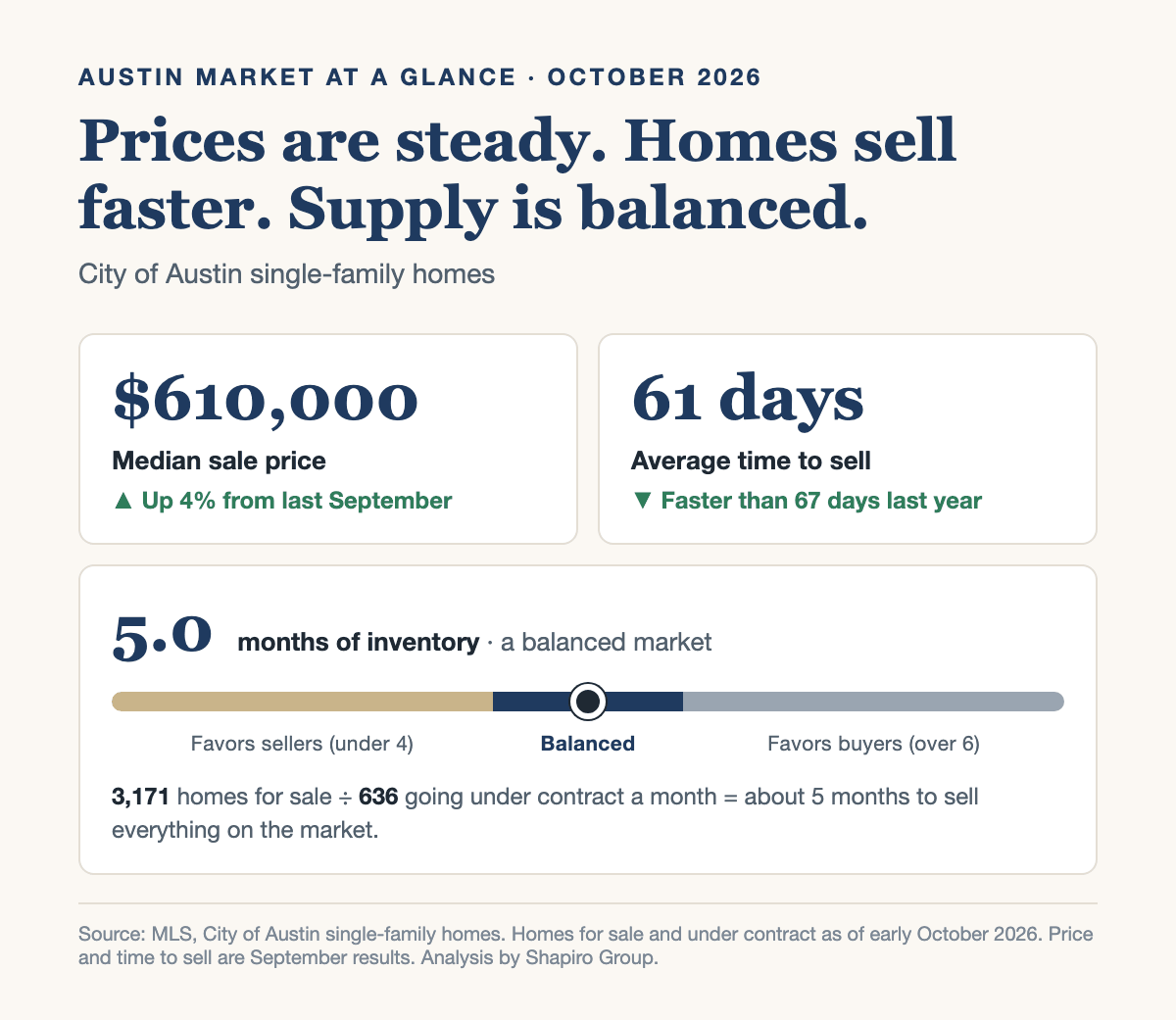
Austin opened October with 3,171 active single-family listings and 636 pending sales over the preceding 30 days. That works out to 4.99 months of inventory—roughly five months of supply at that pending-sales pace.
Together, these figures describe a market where buyers have choices and well-positioned homes are still finding buyers.
Sales are recovering, gradually
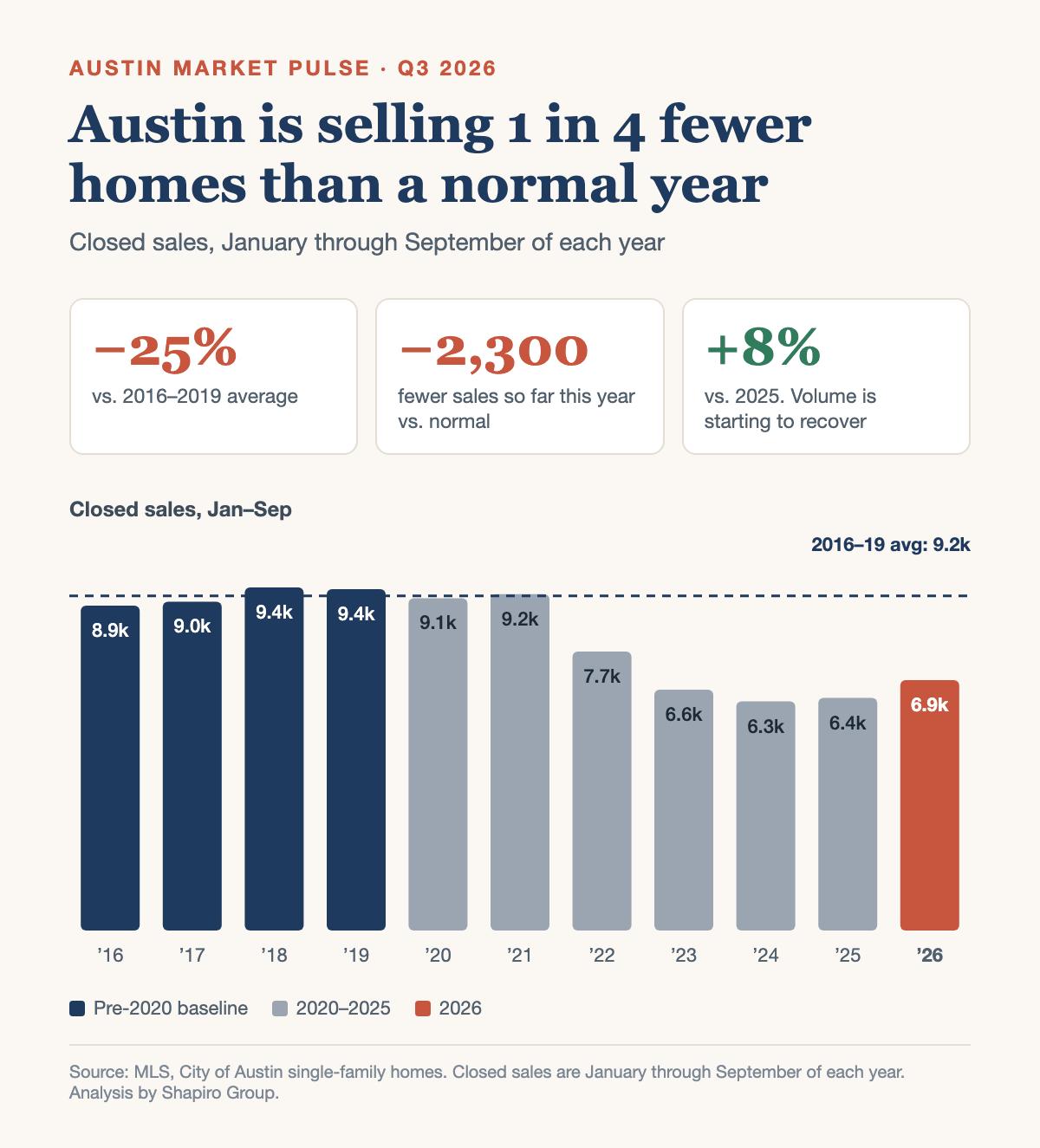
Through September, Austin recorded 6,879 closed sales—about 25% below the average for the same period in 2016–2019. That represents roughly 2,300 fewer transactions than a typical pre-pandemic year.
There is progress, however. Sales through September were approximately 8% ahead of 2025, marking a second consecutive year of improvement from the 2024 low. The recovery has been gradual, with momentum slowing over the summer as interest rates rose.
What these numbers mean for pricing
For homeowners, lower transaction volume makes pricing more nuanced. With fewer recent comparable sales available, setting an asking price requires a close look at local competition, property condition and the most relevant closed transactions.
Citywide price increases also need context. September’s median sale price was $610,000, up 4.4% year over year. The median and average measure different things, and both can shift depending on which homes sell during a given month. A higher citywide figure does not necessarily mean every property has gained value at the same rate.
For buyers
Nearly five months of inventory creates more room to compare properties and negotiate. The seasonal slowdown may offer additional opportunities, especially when a home has been on the market longer or faces several competing listings.
That negotiating room varies from one property to another. Location, condition, asking price and nearby alternatives still shape how much flexibility a seller may have. Buyers can use the broader market as context, then evaluate each home on its own merits.
For sellers
Preparation and pricing deserve particular attention. An average selling time of 61 days—compared with 67 days a year earlier—provides a useful planning benchmark, though individual results will vary. A thoughtful launch, strong presentation and an asking price grounded in recent neighborhood activity can help a home compete.
Ready to talk about your Austin real estate plans?
Whether you’re planning a purchase, preparing to sell or assessing your property’s position in the market, Shapiro Group can help you build a strategy around your goals.
Source: MLS, City of Austin single-family homes, as reported in Shapiro Group’s October 2026 market update. Prices, September closings and selling times reflect September 2026; inventory reflects early October 2026; year-to-date sales cover January–September 2026. Analysis by Shapiro Group.